- Document type
- Book review
- Published
- 3 March 2009
Kiyoshi Kurosawa and Horror - 5 book reviews
A spate of recent books on the Japanese horror film reviewed:
The Films of Kiyoshi Kurosawa: Master of Fear
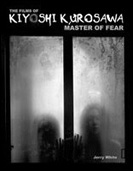
- Author:
- Jerry White
- Publisher:
- Stone Bridge Press
- Review by:
- Nicholas Rucka
At the 2008 Cannes Film Festival, Kiyoshi Kurosawa was awarded the Un Certain Regard Jury Prize for his film Tokyo Sonata. For fans of Kurosawa's films, it was vindication from one of the world's top film festivals of what they've known for years: Kiyoshi Kurosawa is quite simply one of the most interesting and exciting filmmakers working in the world today. The timing, then, of Jerry White's The Films of Kiyoshi Kurosawa: Master of Fear couldn't be better. As the first English language book dedicated entirely to Kiyoshi Kurosawa, it promises to get to the bottom of Kurosawa's raison d'etre: "What is cinema?"
The book charts Kiyoshi Kurosawa's growth as a filmmaker from 'pink film' director to an '…industry maverick who constantly pushes boundaries of staid film genres…" This is done through an introduction to the Asian film phenomenon (the rise of HK Action fandom) and how Kiyoshi Kurosawa fits within the Asian film world. The book then continues on through 25 loosely critical analyses of Kurosawa's films before concluding with an interview with Kurosawa himself. Unfortunately, the problems with Jerry White's book appear almost immediately.
Starting with the introduction, which is designed to be a kind of primer for those who are new to Asian film fandom, Mr. White attempts to connect the dots between the rise of Jackie Chan and John Woo style HK action films and how this led inexorably to J-Horror's popularity and brief box office success. He contends that Asian film fans were turned off by Hollywood's wholesale looting of their prized genre and so they went searching for the next new (obscure) Asian film thing: J-Horror.
I have a problem with this thesis, if for no other reason then the timeline that Jerry White provides doesn't hold true. Tetsuo: The Iron Man (1989) or Evil Dead Trap (1988) or even the Guinea Pig films (1985 and on) all pre-date the J-Horror phenomenon and are not, in a strict sense, even J-Horror films, having all been released before Norio Tsuruta's Real True Scary Stories in 1991. They lack the tropes of the genre and, if we take the example of Tetsuo: The Iron Man, it has long been considered a Sci-Fi flick having been originally marketed in the early 1990s to the kaiju and anime fans by Image Entertainment in the US. I also, quite simply, wonder whether Asian film fans really need any excuse to be constantly on the look out for the next new Asian film phenomenon. Fans are always hungry for the next new thing and I would posit that the success of J-Horror, in some respects, came largely as the result of the ease in bootlegging and fan-subbing Japanese DVDs. The rise in popularity of J-Horror, in turn, came about relatively quickly in the West because by the time Hollywood took notice of it as a genre, it already had a large back catalog to pull from. But, perhaps, this is neither here nor there; it seems that Jerry White chooses this approach because he wants to contrast Kiyoshi Kurosawa as a different kind of horror director from the usual J-Horror subjects, due largely to his diverse back catalog.
The book moves on to Kiyoshi Kurosawa's early years doing pink films. White is correct in describing Kandagawa Wars as a pink film since it'd been made while Kiyoshi Kurosawa was at the Director's Company and was one of two films made by the largely art film focused company for pink movie distributor Million Films. (The other being Banmei Takahashi's Wolf.) But when White turns to The Excitement of the Do-Re-Mi-Fa Girl there are a few errors. I haven't been able to verify whether Nikkatsu Studio did in fact fund the original film version of The Excitement of the Do-Re-Mi-Fa Girl called College Girl: Shameful Seminar, but in all of the Japanese resources I've looked at it says that it was produced by the Director's Company but was denied distribution by Nikkatsu. It was then that Kiyoshi Kurosawa re-shot some key scenes and extended the length of the film.
Where I have some concern about the reporting of these early parts is in the description of Nikkatsu Studios history in the book. Besides the fact that it's an aside that has little relevance to the larger Kurosawa narrative except in a failed attempt to draw a comparison between famously black-balled Nikkatsu director Seijun Suzuki and Kiyoshi Kurosawa himself (possibly inspired by a reference to Suzuki in the chapter on Kurosawa from Tom Mes and Jasper Sharp's The Midnight Eye Guide to New Japanese Film), the book has to contend with a key mistake that is often made: Nikkatsu Roman Pornos are not that same as pink films. 'Pink films' are independently produced soft-core films made by a small number of companies specifically for cinemas who play their products. Roman Porno films can't be considered pink, as Nikkatsu Studios owned their own cinema chains as well as the studios and stopped producing them in the early 1980s. Additionally, though of less importance to this conversation, the budgets, production facilities and film quality was usually higher with the Nikkatsu Roman Porno.
Moving on to the incompatible Seijun Suzuki comparison, Jerry White writes the following:
"This transformation from "legitimate" cinema to pinku eiga resulted from a financial crisis: if the company did not start turning a profit, it was going to go bankrupt. (Needing a scapegoat, Nikkatsu fired its best director, Seijun Suzuki; the company's downfall was blamed on his "incomprehensible" films, specifically Branded to Kill…) (p. 37)
Besides the fact that this is erroneous, the timeline is also out of whack. Branded to Kill was released in 1967 while Nikkatsu's move to a full Roman Porno line-up occurred in 1971. Seijun Suzuki's firing had less to do with making incomprehensible films (which were, in fact, popular enough) than with his disrespect for the 'corporate suits.' Part of the incompatibility of the Suzuki/Kurosawa comparison comes from the fact that the former was under contract to Nikkatsu and as such was a wage slave for the studio churning out the requisite number of films a year, while the latter was not. Kiyoshi Kurosawa was happily ensconced with the 'artistic' filmmakers over at the Director's Company and, as such, didn't have to produce program pictures.
As for the rest of the book, the bulk it is comprised of film reviews that follow a simple pattern: first, we have an introduction to the specific Kiyoshi Kurosawa film and then we get a plot description peppered with some mild analysis that is periodically bolstered by quotes from various critical texts. Much of the research, it appears, has been pulled from articles found on the web but for the few book entries that there are, there's no footnoting or pagination by which one can go and verify the quote. In fact, considering how few secondary sources Jerry White used, I wonder why he didn't just put everything in foot or chapter endnotes for ease of use? As such, the write-ups are essentially super-charged plot synopses.
That said, the highlight of the book for me was the interview the author has with the man of the hour, Kiyoshi Kurosawa. I found this to be most interesting primarily because reading Kurosawa's own thoughts about films and the filmmaking process is something that is startlingly (and curiously) rare in English. Midnight Eye has two interviews with Kiyoshi Kurosawa (here and here), but outside of this, we have yet to have much else, including Kurosawa's books of essays, translated into English. Back in 2004 I had the honor of interpreting for Kiyoshi Kurosawa when he came to NYC. During his trip I interpreted at interviews with two different sets of writers who were working on Kiyoshi Kurosawa books at that time. As far as I know, neither of those books have been published.
Ultimately, I think what I was hungering for in this book was a large picture perspective/portrait of Kiyoshi Kurosawa; one which analyzed his films for thematic through-lines and directorial choices, as seen in the changes in the Japanese film industry over the last 25 years. That's not this book and, it seems, that the definitive overarching question has yet to be seriously explored: Why is a genre director (something viewed as only slightly better than a cockroach by the world of film criticism) like Kiyoshi Kurosawa one of the most highly regarded filmmakers in Japan?
While Jerry White does provide some interesting information about Kiyoshi Kurosawa and the plot synopses are of some utility, the occasional factual error and the limitation of scholarship make for a frustrating read. Ultimately, I'm afraid that we'll have to wait longer for a definitive book in English on Kiyoshi Kurosawa and his films.
Availability
The Films of Kiyoshi Kurosawa: Master of Fear
- Author:
- Jerry White
- Publisher:
- Stone Bridge Press
Mon effroyable histoire du cinéma
- Authors:
- Kiyoshi Kurosawa and Makoto Shinozaki
- Publisher:
- Rouge Profond
- Review by:
- Tom Mes
France is a country where Kiyoshi Kurosawa has had a higher profile than elsewhere in the West, so it is no surprise that French readers have been blessed with no less than two books about him (plus a translation of Kurosawa's own novelisation of his film Pulse). Both were released by the same publisher, Rouge Profond. Kiyoshi Kurosawa: Mémoire de la disparition is an analytical essay by Diane Arnaud, while Mon effroyable histoire du cinéma is a translation of a book-length interview with Kurosawa by one of his protégés, the filmmaker and critic Makoto Shinozaki (director of Not Forgotten and Okaeri).
Mon effroyable histoire du cinéma is a gripping descent into Kurosawa's fascination with horror films. Shinozaki, himself a longtime genre fanatic, is the ideal man for the job. First gaining notice for his long interviews with a variety of filmmakers from around the world, he was one of the members of the cinéclub at Rikkyo University whose visions of film and filmmaking were shaped by the lectures Kurosawa gave there. Shinozaki's own career in filmmaking began as Kurosawa's assistant on the making of the heavily self-referential The Guard from Underground.
The conversation transcribed in these pages take the reader on a trek through the history of the Japanese horror film, as the pair joyfully reminisces about scores of titles completely unknown outside their homeland - despite all the recent efforts of writers and distributors alike, we have only just begun to scratch the surface of the Japanese horror genre. Kurosawa also gives due notice to Chiaki Konaka and Norio Tsuruta as inventors of the style known today as J-horror, which he defines as "a typically Japanese way to create fear."
But the scope is not limited to Japan. Tobe Hooper is a constant presence and the book includes a chapter devoted entirely to his films. Nothing more than a faded one-hit wonder to most, Hooper is nothing less than a master in the eyes of Kurosawa, who can back up his beliefs with very solid arguments. There are more than a few examples of such "sacrilege" to the horror canon, as the director expresses his doubts about such sacrosanct offerings as Dawn of the Dead (he prefers Fulci's Zombi), Halloween (which he calls "banal") and Psycho (he compares the shower scene to several sequences in The Texas Chainsaw Massacre, in favour of the latter).
Mon effroyable histoire du cinéma is at once an interview, a biography, a history, a monograph and a lesson in cinema. It is also an unabashed expression of cinephilia: reading Kurosawa and Shinozaki's fascinating exchange, which takes them from Hooper to Cassavetes to Wenders to Godard and back to Carpenter and Fulci, all with equal glee, it becomes quite clear to the reader how pointless it is to separate "genre" and "arthouse". By building fences, you only end up imprisoning yourself.
Availability
Mon effroyable histoire du cinéma
- Authors:
- Kiyoshi Kurosawa and Makoto Shinozaki
- Publisher:
- Rouge Profond
Buy at:
Flowers From Hell: The Modern Japanese Horror Film
- Author:
- Jim Harper
- Publisher:
- Noir Publishing
- Review by:
- Jasper Sharp
Kiyoshi Kurosawa is one of the many directors whose films fall under the spotlight in Jim Harper's admirably broad overview of Japanese horror, Flowers From Hell, although frustratingly the author rather cops out in his introduction, denying Kurosawa the chapter he most certainly deserves with the disclaimer that his "auteurist approach makes it difficult to create a credible overview of his work without covering his many non-horror efforts; he simply cannot be assessed effectively from a purely horror perspective." [pg 9] Well, that's possibly true, but given that most of the reviews I've seen for the recent UK release of Tokyo Sonata misleadingly assert that the director's latest is a radical departure into non-genre territory, while those familiar with his back catalogue are more likely to view it in terms of a similar approach applied to issues more solidly grounded in the real world, surely some sort of analysis as to what makes Kurosawa's horror films "horror" and what sets them aside from his other works like License to Live, Barren Illusion and Bright Future might bring its own insights into how one defines horror as a cinematic genre.
To be fair, however, theorizing and formal analysis is not really what Harper's book is about (one notes the lack of footnotes and citations, for example). In this respect, it comes as something of a breath of fresh air - far too much recent writing about Japanese horror, especially in the academic field, has had a tendency to stumble into rather awkward territory in its attempts at drawing conclusions about what these films say about contemporary Japanese society.
Instead, what we have is a more straightforward overview of what's out there, giving a fuller impression of the range of films that make up the J-horror genre. Indeed, what Flowers From Hell lacks in depth, it certainly makes up for in breadth. In its nine chapters, whose headings include "Vengeful Spirits"; "The 1980s: Splatter and Beyond", "Hideo Nakata and the Ring Cycle", "Love and Mutation: The Works of Junji Ito on Film" and "The Post-Juon Horror Film", alongside the obvious titles that regularly come up for discussion (Ring, Audition, Ju-on, etc), there's also more off-the-radar stuff like Masayuki Ochiai's Hypnosis (1999), Toshiharu Ikeda's The Man Behind the Scissors (2004), Ryu Kaneda's Boogiepop and Others (2000) and Joji Matsuoka's Phantom of the Toilet (1995). You can't help but admire Harper's stamina - he's certainly seen one hell of a lot of films. Whether there's anything interesting to say about the likes of St John's Wort (2001) is another matter, which probably accounts for why much of the book consists of plot summaries and background info about what else the various cast and crew members have done, but little beyond that. It's an entertaining enough read, if not particularly challenging or insightful, and should prove useful for horror fans looking to expand their collections beyond the more familiar touchstones.
With this in mind, I've got two main criticisms. Firstly, and perhaps unsurprisingly given that Harper's sphere of expertise is horror, not Japanese film (he previous wrote Legacy of Blood: A Comprehensive Guide to Slasher Movies, published in 2004), there's the odd typo and mis-transliteration of the Japanese, though none of this is too heinous given the target audience, and doesn't distort the picture of the genre he's trying to present. For example, the original title of Norio Tsuruta's Real True Scary Stories (1991), 'Honto ni atta kowai hanashi', is given as 'Honto ni atta kawai hanashi' (dangerously close to 'Real Cute Stories'!), and again, there's the usual confusion about Nikkatsu's Roman Porno films being pink eiga. Secondly, the coverage is predominately post-1980s films, with no attempt to hark back to the origins of the genre, the various Ghost Cat and Ghost of Yotsuya titles from the 1920s and 1930s. This might be explained by the sheer difficulty in getting access to those titles that survive from the pre-war period, and one assumes that the author is more interested in pointing the reader to what's currently out there on DVD. That said, I would have thought the films of Nobuo Nakagawa might be worth a bit more investigation, but I guess that given the book's sub-title is "The Modern Japanese Horror Film", one shouldn't really gripe.
These reservations aside, along with the relevant chapters of Dennis Meikle's The Ring Companion, Flowers in Hell is about the best guide for casual readers as to what's out there, and both books prove that topics such as J-Horror are far better served by genre fans than by academics.
Availability
Flowers From Hell: The Modern Japanese Horror Film
- Author:
- Jim Harper
- Publisher:
- Noir Publishing
Introduction to Japanese Horror Film
- Author:
- Colette Balmain
- Publisher:
- Edinburgh University Press
- Review by:
- Jasper Sharp
Japanese horror seems to have joined anime as a particularly voguish topic for scholarly dissection these past few years, but so far we've yet to see an academic study horror in which the research matches up to the jargon. Leading the charge back in 2005, the Jay McRoy-edited anthology Japanese Horror Cinema was, on the whole, a disappointment, and was characteristic in its favouring of theory over fact. I've yet to see McRoy's solo effort Nightmare Japan: Contemporary Japanese Horror Cinema published early in 2008, but Colette Balmain's recent Introduction to Japanese Horror Film really makes one question the purpose of Film Studies as an academic discipline.
Firstly, though the author herself acknowledges the problem of "how one defines horror and so identifies its essential features", I wonder why so many studies so far (and I include Jim Harper's Flowers From Hell in this) have delimited the subject by looking at "the origins, themes and conventions of Japanese horror cinema from 1950 to date" when works based on the kaidan such as Tales of the Peony Lantern and The Ghost of Yotsuya were being made in the 1910s, early German precursors to the genre such as The Golem (1915), The Cabinet of Dr. Caligari (1920) and The Student of Prague (1913) were making it to Japan within years of their domestic releases, and the ero-guro literary genre led by writers like Edogawa Rampo thrived in the 1920s. And why, oh why, do so many insist on looking at Nikkatsu Roman Porno films such as the Angel Guts series as being made for the horror market?
Unfortunately, issues of scope prove to be the least of the book's problems. The first chapter entitled "Laying the Foundations" immediately set alarm bells ringing. According to Balmain, Nikkatsu Studios "would eventually close its doors for good in 1988" (pg 13; actually it went bankrupt in 1992 though was bought up by Namco the following year, and is still a considerable presence in the industry today); Shochiku was the first major studio to use actresses (pg 13; actually they were beaten to it by Nikkatsu, and even several years earlier by Tenkatsu and Taikatsu) and was "the main financier of the Art Theatre Guild" (pg 14; no, this was Toho); Toei "produced nine out of the ten best-selling films in Japan" in 2005 (pg 14; sorry, it was Toho again, and they distributed nine out of the ten top-grossing films; many of these were produced out of house) and also "is the home of Hayao Miyazaki" (it barely needs mentioning here that Studio Ghibli has nothing to do with Toei, having been established as a subsidiary of the publishing company Tokuma Shoten); and Daiei "went bankrupt in 1971, only to emerge as Kadokawa Pictures in 2002" (pg 14; Daiei was bought up by Tokuma following its bankrupcy, and continued to produce films all the way up until it passed over into Kadokawa's hands; Kadokawa had been involved in film production in its own right since the mid-70s).
Macrons and Western name orders are used inconsistently and Japanese terms are routinely misspelt ("shakiamono" instead of "shakai-mono"; "tateme" instead of "tatemae"; "mekeke" instead of "mekake") or misapplied: apparently Wild Zero "is continuing within the tradition of youth-orientated films, known as Sun Tribe or taiyozoku films" [pg 118], while Versus "is representative of a trend in Japanese visual art towards what is known as the 'super-flat aesthetic'" [pg 116]. Most of this could have been detected as the complete piffle that it is by a quick Google search. Given that this is a university press publishing an academic book by, I am informed on the back cover, a university Senior Lecturer, surely at some point in the process the services of a fact-checker, proofreader or just someone who knew a little more about Japanese language, cinema and culture could have been solicited.
All of this robs the text of any of the necessary authority the author strives for in servicing the same Orientalist "explanations" of the films that sadly seems to have become standard for books of this type. Anyone with even the slightest acquaintance with the language could see through such ludicrous falsehoods as "the Japanese language does not distinguish between the personal pronouns 'I' and 'you', or 'self' and 'other'; instead the relationship between self and other in Japanese culture is one in which 'the self immerse[s] itself in the other'" [pg 37] and what is implied by it - this bizarre assertion, like so many others within these pages, is presented as hard fact by backing it up with a quote that itself could do with far closer circumspection (in this case from an essay by Chon Noreiga published in the 2006 anthology Asian Cinemas: A Reader and Guide).
Ironic then that Balmain's book ends with a passage from Edward Said's Orientalism, his seminal study from 1978 of Western academia's fabrication of a fictitious Eastern other; "Rather than a manufactured clash of civilizations, we need to concentrate on the slow working together of cultures that overlap, borrow from each other, and live together in far more interesting ways that any abridged or inauthentic mode of understanding can allow." [pg 190]. I say ironic, because Balmain's books falls right into the trap of constructing an image of a foreign society through a collage of second-hand, misappropriated or downright irrelevant citations. Opinions such as "In contemporary Japanese cinema, the motifs of alienation, emptiness and isolation contained with an apocalyptic mise-en-scene of techno-horror, articulate urban alienation in a society dominated by the image, commodity fetishisation and economic instability" [pg 168] are all too typical within its pages, and do more to reinforce any "manufactured clash of civilizations" than counter it.
Film critics and scholars alike would do better to stick with the immediate evidence at hand (i.e. the films) rather than perpetuate dubious value judgements about a culture with which they clearly have had no direct contact. The portrait here of Japan as a sheeplike, paranoid and neurotic society cowering against the cumulative threats of changing gender roles, technological advance, economic uncertainty, the erosion of the family unit and alien "Western" concepts of "individualism" forced upon them during the Occupation would probably have given even Ruth Benedict cause for alarm. A couple of months in Japan and one can recognise the same problems as existing in any other post-industrial society. In other words, J-Horror appeals to universal, not Japanese-specific fears, which is why the films have travelled as far as they have, and while we're at it, why producers such as Takashige Ichise have been so successful at specifically targeting his films at overseas audiences, a point that surprisingly few writers seem to have picked up on.
Availability
Introduction to Japanese Horror Film
- Author:
- Colette Balmain
- Publisher:
- Edinburgh University Press
East Asian Cinemas: Exploring Transnational Connections on Film
- Author:
- Leon Hunt and Leung Wing-Fai (eds)
- Publisher:
- I.B. Tauris
- Review by:
- Jasper Sharp
The global market for J-horror, particularly the issues surrounding Western marketing and Hollywood remakes, is one of the areas focused on in the academic anthology East Asian Cinemas: Exploring Transnational Connections on Film, which covers a pan-Asian cinematic output while acknowledging in its introduction that 'Asia' as a concept is "a free-floating signifier - a term the exact meaning of which is not yet settled" [pg 5]; in other words, the culture, history, politics and sense of shared values and identity of a region that encompasses Tokyo, the Philippines, Thailand and China, bares little correspondence with, for example, Europe. 'Asian cinema' as a brand might be currently viewed as an alternative to American or European cinema, and the Hollywood aesthetic might well have become considerably more "Asianized" over the past decade or so, but what exactly this means in practice is the subject of considerable debate, a debate in which the various writers in this anthology fruitfully engage.
As is usual for books of this nature, the quality of the individual essays is variable, and I won't deny there aren't some mistakes here and there, but the standard is high overall, and the editors should be particularly congratulated in the way that the individual sections nicely link up with one another to ensure that the book as a whole adds up to far more than the sum of its parts. There are plenty of fascinating facts and insights contained within these pages to inspire further directions for research. David Desser "Remaking Seven Samurai in World Cinema", for example, mentions the attempts of Masaichi Nagata of Daiei and Run Run Shaw of Shaw Brothers to establish the first Southeast Asia Film Festival in 1954, while Gary Needham's "Fashioning Modernity: Hollywood and the Hong Kong Musical 1957-64" covers Hong Kong co-productions with other countries, including Britain and Japan, and looks at how the industry drew inspiration from foreign productions to create its own borderless world not dissimilar to that being portrayed in Hollywood films.
Of particular relevance to Japanese film scholars is Rayna Denison's "The Language of the Blockbuster: Promotion, Princess Mononoke and the Daihitto in Japanese Film Culture" and Gary G. Xu's "Remaking East Asia, Outsourcing Hollywood", which covers Roy Lee and the remakes of The Ring, The Grudge et al. The role of Western personalities such as Quentin Tarantino and Luc Besson in bringing the East to the West is also covered, in Nikki Lee's "Salute to Mr. Vengeance! The Making of a Transnational Auteur Park Chan-Wook" and Leon Hunt's "Asiaphilia, Asianisation and the Gatekeep Auteur: Quentin Tarantino and Luc Besson."
All in all, East Asian Cinemas: Exploring Transnational Connections on Film does exactly what it says on the cover, providing a revealing and much-needed look at how the various industries that make up the catch-all term of "Asian Cinema" relate to each other, as well as to the rest of the world.
Availability
East Asian Cinemas: Exploring Transnational Connections on Film
- Author:
- Leon Hunt and Leung Wing-Fai (eds)
- Publisher:
- I.B. Tauris