Sukiyaki Western Django
- Year
- 2007
- Original title
- Sukiyaki Western Django
- Japanese title
- Sukiyaki Uestan Jango
- スキヤキ・ウエスタン ジャンゴ
- Director
- Cast
- Running time
- 121 minutes
- Published
- 17 September 2007
by Tom Mes
In the introduction to his groundbreaking book Spaghetti Westerns, the great English film historian Christopher Frayling recounts how he once faced an audience of angry Italians who didn't take too kindly to the title of his tome. Why the hell would the first serious study of the Italian western carry the same derogatory term that critics everywhere had been using to write off these films, they wondered. Professor Frayling, no doubt accustomed to obstinate crowds, calmly explained that spaghetti was a dish brought over from Asia by an Italian, which the Italians subsequently transformed into something truly their own: a national food. Similarly, they had taken the western from America and turned it into a uniquely Italian genre. The analogy, therefore, was anything but an insult.
The same logic can be applied to the title of Takashi Miike's latest genre-bending extravaganza Sukiyaki Western Django. Sukiyaki is a beef dish, and beef wasn't eaten in Japan until the foreign influence of the early Meiji era made it first acceptable and subsequently fashionable. Since then it has become so thoroughly assimilated that no one in the world would ever think of sukiyaki as being anything but an intrinsically Japanese dish. Just as no one watching Sukiyaki Western Django would ever mistake it as being anything other than a Takashi Miike film.
Let's get an important point out of the way first: Sukiyaki Western Django is not the first Japanese western. In the early 1960s, the Nikkatsu studio specialised in peculiar bastardizations of the genre that had Japanese cowboys riding the hills and plains of Hokkaido and coming to the aid of the downtrodden. It's not even the first film to re-apply the aesthetics of the spaghetti western to the chanbara genre, as demonstrated by the very perceptive inclusion of Eiichi Kudo's raucously entertaining The Fort of Death (Gonin no Shokin Kasegi, 1969) in the spaghetti western retro that ran concurrent with Miike's film at the 2007 Venice Film Festival. Kudo's film features an opening scene lifted wholesale from The Good, The Bad, and The Ugly and gives a prominent role to the iconic Gatling gun that also pops up in Sukiyaki Western Django.
The mix-and-match quality evoked by the titular delicacy is echoed in Miike's film, which carries its influences on its sleeve: there is a lot of Kurosawa and a lot of Leone, a generous sprinkling of Corbucci, a touch of Okamoto, and a whiff of Gosha. More than just a reminder of the debt the Italians owe the Japanese through the Yojinbo-Fistful of Dollars connection, the film adheres to the far wiser stance that cross-cultural pollination is the essence of cinema and that there is no such thing as a one-way street of influence. As university professors everywhere like to phrase it, cinema is inherently transnational, and Sukiyaki Western Django is that statement made flesh.
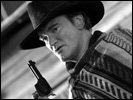
Borderlessness is what best characterizes this film: Samurai mix with cowboys, Shakespeare with the Heike-Genji wars, outdoor locations alternate with theatrical backdrops based on ukiyo-e designs, and action melds with modern dance. Quentin Tarantino's brand of ultra-postmodernism and cinematographic in-jokes mark the film as a whole, and he also shows up in it as a gunslinger named Piringo (a contraction of Pierrot and Ringo, very fitting in this context). In fact, with its freeform mixture of popular genres from the 1960s and 70s, Sukiyaki Western Django could easily have served as the third - and best - entry in Tarantino's Grindhouse project. There's even a fake trailer for a spin-off movie included in the later stages of the film.
Genre, nationality, chronology, even gender - in this film, all boundaries are blurred. The Japanese cast speaks English. Events are replayed after they've already happened. Benkei the warrior monk's emasculation releases repressed homosexual urges for his fair protégé Yoshitsune, who promptly shoots him with his Colt .45. Sukiyaki Western Django has a thousand roots, but no borders.
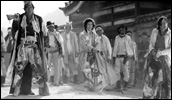
It all starts out familiar enough: a lone, nameless gunslinger (Ito) rides into town and finds himself in the demilitarized zone between two powerful rival factions. Aided by the handful of marginals on the periphery of the conflict, his presence breaks the stalemate and accelerates the long-delayed confrontation between the opposing clans. Just another Red Harvest/Yojimbo variation then? Of course not. Perhaps the most radical intervention - even if less conspicuous than Michiko Kitamura's wild costume designs, Takashi Sasaki's gorgeously mudcaked sets, and the autumnal splendor of the Yamagata locations as captured by DP Toyomichi Kurita - is the passive role of the protagonist. Ito, star of the Umizaru films and cast for his resemblance to spaghetti western luminary Giuliano Gemma, is overshadowed as an actor and as a screen presence by Yusuke Iseya, who is a stand-out as Yoshitsune the leader of the white Genji clan, Teruyuki Kagawa as the town's corrupt sheriff whose swerving alliances have turned him into a schizophrenic, and Koichi Sato as Kiyomori, head of the red Heike gang. But not all the blame (if blame is even the proper word) for this can be laid on Ito's shoulders. The villains are far more active and far less cowardly than they tend to be in this type of scenario, just as the hero is less superhuman than is the custom. The result is a big boost of freshness and vitality that makes archetypes, codes and clichés feel like they were invented yesterday.
But what of the English dialogue? This has already proven a moot point, seen as a kind of key as to whether this film will "work" or not. Just as the movie can't be reduced to a rehashing of genre or an imitation of earlier films, narrowing the focus to mere dialogue delivery would also be a mistake. Firstly, having Japanese actors speak English is not such a bizarre choice for a director who grew up watching Japanese-dubbed Italian westerns on TV (and while we're on the subject of the transnational, remember that these were Italian films shot in Spain starring American actors to begin with). Yes, the film was shown with English subtitles in Venice - where it marked Miike's first time in competition at one of the three main film festivals, after having been featured in sidebars at Cannes, Berlin, and the Mostra in previous years - and they proved to be most helpful. Iseya, Kagawa, and Kimura have noticeably the best grasp of the language, while the rest of the cast try hard but mostly fail to deliver more than phonetic mumbling. Is this a hindrance to the audience? For some native English speakers maybe, but it's a big world and most of it will watch this film subtitled or dubbed into their own language anyway. What's more, even awkward natural delivery is preferable to the disembodied voices of a professional dub cast. You came to see a Japanese tribute to an Italian variation on an American genre; don't complain that it's not the Royal Shakespeare Company.
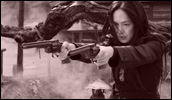
As noted, narrowing the film or the acting down to mere dialogue delivery would be a mistake. Watch it once to read the subtitles. Then watch it again to notice how important body movement and motion are in this film. Look at the facial expressions, sense the rhythm and the role of music and dance (further refined from the experiments in Izo and Big Bang Love, Juvenile A). Miike, if nothing else, is a master of movement, of motion, rhythm, and grace (even if it's of a crude variety at times), and Sukiyaki Western Django is one of the most accomplished and purest expressions of this quality. It's in Kurita's handling of the camera, but also very strongly in the acting: in Iseya's feline grace in handling the katana, Kimura's sensuality and agility, Sato's rough physicality, Kagawa's jittery pantomime, Yutaka Matsushige's monkey-esque skulking, and in Momoi's entirely believable transformation from pigtailed ingénue to squeaky-jointed old bag to double-barreled action heroine.
Sukiyaki Western Django is not the Miike movie with the bad English. Sukiyaki Western Django is the movie that best embodies the freedom, the joy, the vitality, and the lucidity that form the basis of Takashi Miike's filmmaking.