Remembering Kenji Misumi
- published
- 24 October 2005
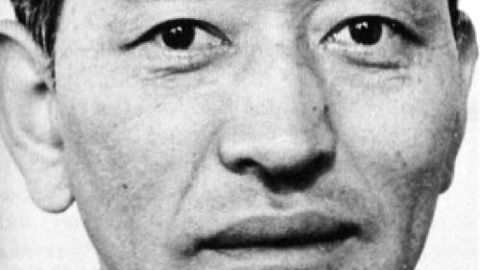
To this day, many jidai-geki directors from the heydays of Japanese cinema have authored autobiographies or authorized the publication of biographies which mix theory about their work with lengthy, in-depth interviews. However, browsing the bookshelves of major Tokyo bookstores, you will soon notice the conspicuous absence of any book about Kenji Misumi.
The reason might seem fairly simple: the only existing book about Misumi has been out of print since the collapse of its publishing company. But other reasons might be brought to the fore: first, death caught Misumi unexpectedly at the age of 53, preventing him from writing anything about his life and work. (This is also the case of other major Japanese directors, such as Mizoguchi, who died at the age of 58. An exception is Raizo Ichikawa, Misumi's favorite actor, who managed to write his autobiography shortly before cancer defeated him at the tender age of 37). Second, in Japan, Misumi, as surprising at is may seem, is generally not considered a director worthy of study, whereas such Daiei colleagues as Kazuo Mori, Tokuzo Tanaka and Yasuzo Masumura have already attracted the attention of film critics.
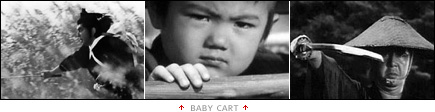
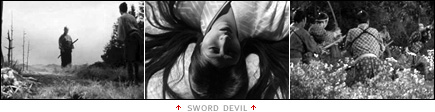
Conversely, Kenji Misumi has become in the West one of the most written about chanbara directors. His Baby Cart movies continue to fascinate and enthral - more often than not for reasons of gore - while some of his lesser-known films - such as Sword Devil (Kenki, 1965) or Destiny's Son (Kiru, 1962) - have begun to get major critical acclaim. Therefore, the time seems to be ripe to reveal how Misumi is considered in Japan, and how accurate or misguided the vision that Westerners have of his films might be.
In Japan, Misumi's films have not been without their fair share of critical attention. Whereas most studio-bound quickies (films usually shot in 2 to 3 weeks) were generally discarded as mere entertainment fodder by critics, the films of Misumi began to garner favorable if not positive reviews in the 1960s. One of Misumi's assistants, Mitsuaki Tsuji, who, ironically, never held Misumi in very high esteem due to personality incompatibility, once commented: "unbelievably, a journalist had written at the time of Destiny's Son that Misumi's aesthetic sense in showing carnage pointed to an unconscious author".
The words "unconscious author" are interesting in so far as they point to the old critical debate regarding "auteur" directors and "program picture directors". It seems fairly reasonable to say that Misumi has never been considered an "author" by Japanese film historians in the West; at best, French critic Max Tessier described him as a "superior craftsman", which indeed corresponds to what Misumi was in the realm of Daiei craftsmanship. But if "auteur directors" are to be found in artistic resistance to commercial dominion, then Misumi deserves the right to be labeled an "auteur". His best films display an elaborate visual language whose semi-abstraction often defied the commercial law of the time, which was to shoot entertainment pictures as fast as possible.
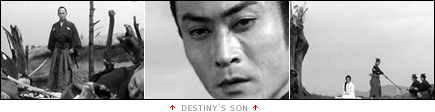
Like Teinosuke Kinugasa, his mentor, Misumi revelled in impressionism, whose aim is to redefine reality through the art of montage and visual abstractions. Some of his collaborators reveal that Misumi really devoted himself to refining and surpassing his visual artistry - though not always with success. One of the very first scripts to excite Misumi visually was that of Destiny's Son. It was written by Kaneto Shindo, a director whose visual ability allowed him to film tales almost devoid of dialogue (such as Naked Island, 1961). "The script of Destiny's Son was quite abstract, very poetical, and we tried as much as we could to find images to fit the words," commented set decorator Akira Naito, whose own visual ambition contributed to augment that of Misumi. Destiny's Son, the film, features some of Misumi's best trademarks, both narrative and visual: ellipsis, eery tapestries of desolate greenery, the sense of tempo peculiar to his sword duels and fights, and the manga-like violence that would later make Misumi the director most attuned to adapting Lone Wolf and Cub to the big screen. Watching Destiny's Son defines the meaning of 'visual enthralment'. It is also - though this remains to be verified - one of the very first chanbara films to touch upon quasi-Freudian areas of the samurai psyche, very much like what Hitchcock had done one year earlier with the thriller genre in Psycho - although Misumi sees no need to explain anything at the end of the day.
Shooting Destiny's Son was a real artistic pleasure for director Kenji Misumi and his set decorator Akira Naito, who, together, designed the very best cinematic artistry Daiei had to offer through the sixties, verging on expressionism with artificial sets sometimes grafted on outdoor sceneries. But Misumi - and this is a recurring factor throughout his career - did not often succeed in bringing forth visually what he had in mind. "He was not satisfied with the shot where the blade of the sword crosses the sun sphere," reveals Akira Naito. "He aimed at a more complex imagery but simply could not come up with it and had to give up".
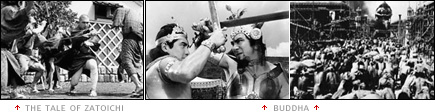
Misumi's visual endeavours contributed to make him one of the slowest-working directors at Daiei, very much like his mentor Teinosuke Kinugasa. And when a director was slow-working, producers would, more often than not, dispatch another director to work with him and help finish the shoot as soon as possible. Before he made Buddha (1961) and The Tale of Zatoichi (1962), two of the biggest commercial hits for Daiei, producer Masaichi Nagata had Misumi cope with rival-to-be Tokuzo Tanaka on the set of the first two Satan's Sword movies (1960). Tanaka, who knew he could work much faster than Misumi, did his best to impress Nagata, but Misumi's command of the visual language and film techniques made him the best possible choice for helming the 70 mm "blockbuster" Buddha - although it is said that Nagata's true wish was to offer the project to a director possessing the stature of a Mizoguchi.
"Little Mizoguchi" was a nickname Misumi gained in the late 1960s, when his reputation as a brilliant craftsman was at its highest. Although Misumi was a Daiei pioneer in the making of more or less bloody jidai-geki, his core sensitivity was towards poetry and abstraction - this is why his most dialogue-driven films are often his worst. After Kenji Mizoguchi died, Misumi was the one director seen as capable of helming "female-oriented" films at Daiei. This is why he made Namidagawa in 1967, with regular actress Shiho Fujimura. Some even say that the natural "feminine side" of Misumi - who as a child was raised by women only - was something actor Tomisaburo Wakayama initially despised, before taking to Misumi's talent as a rigorous director of samurai epics.
The Baby Cart saga was produced between 1972 and 1973 after the downfall of the Daiei studio. For Misumi, the project meant coming back to feature films after a forced stint as a TV director. Everything he had learnt, all the skills he had honed at Daiei, he must have applied to Baby Cart. The original material - Kazuo Koike and Goseki Kojima's gekiga - was quite stimulating and appealed to his visual senses. Thus, watching Misumi's Baby Cart movies is like watching a manga come to life, with Misumi doing in 1972 on film what Japanese animation was only beginning to fulfil on TV and in feature films. But once again, Misumi, an auteur with moments of weakness, did not always manage to materialize on the screen what images he might have formed in his head. This is why some of the most amazing - or spectacular - shots of Misumi's Baby Cart movies are to be credited to editor Toshio Taniguchi or cameraman Chishi Makiura rather than to Misumi alone.
The death of Misumi put an abrupt end to the maturation of his talent as a visual storyteller - recognized by all his peers. But his mastery would trigger many a vocation; assistant Mitsuaki Tsuji revealed that in the late 1960s, some aspiring assistant directors came knocking at the doors of Daiei only because they had seen Destiny's Son, which they regarded as a visual masterpiece. In an interview about Baby Cart, fellow director Yoshiyuki Kuroda revealed that Misumi was a role model for him as a director, as for any director who wished to improve their cinematic skills. Furthermore, Eiichi Kudo, one of Toei's most gifted directors, thought Misumi to be a "terrific rival".
As Misumi's posthumous reputation started to grow, one man, who had fallen in love with the director's artistry, dared write the very first biographical book about him. The bulky, 350-page volume was published in 1997 by the now defunct Yotsuya Round publishers. In order to write this seminal book, its author, journalist Kazuma Nozawa, met several key collaborators of Misumi and tried to learn as much as he could about his private personality - which proved difficult. The private nature of Misumi is still, to this day, a well-guarded secret. Some describe him as a misanthrope, others as a very kind man who somehow hid his kindness behind a cold cynicism. It is not too daring to say that the sense of solitude and gloom that surrounds much of Misumi's private life also pervades his work as a filmmaker.
There is at least one thing author Kazuma Nozawa wishes to stress about Misumi: that he is not a director of bloody chanbara as he is often seen in the West (mainly because of the Baby Cart cut-up Shogun Assassin in the 1980s). Misumi's true nature is to be found in a clear contrast between poetry and nihilism. Moreover, the Zatoichi films Misumi directed were often the series' most human entries; Misumi always refrained from showing Zatoichi as a superman, having defined the existential melancholy and ambiguity of the character in the very first film.
Another collaborator of Misumi stressed in his own autobiographical book that Misumi's true dream might have been to become a full-fledged scriptwriter as well as a director. The only time Misumi was allowed to fulfil this particular wish was on Last Samurai, his final feature film made in 1974. Unfortunately, the film was both an artistic and commercial failure due to various incompatibilities between a former Daiei director and Shochiku crews. But the fact that Misumi was allowed to write his own script further accredits the "auteuristic" ambitions of the director.
I wish to end this short overview of Misumi's work with a very revealing account from a person whose identity I will keep secret. This person - a close collaborator of Akira Kurosawa - once said to me that "as a young boy, watching Toei sword-movies was exciting; you left the theatre wanting to seize a piece of wood and stage fake fights with your friends. But watching Misumi's sword movies was like plunging into a well of sadness and melancholy which never left you untouched."
Probably, these are the most beautiful words ever pronounced about Kenji Misumi, a director whose work still deserves to be more fully explored. [RG]
Satan's Sword (Daibosatsu Toge, 1960)
- Cast
- Raizo ICHIKAWA, Kojiro HONGO, Tamao NAKAMURA, Chishu RYU
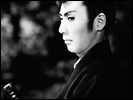 The saga of Daibosatsu Toge, or Great Buddha Pass, is one of those mainstays of the chanbara genre. That Kihachi Okamoto's Sword of Doom is perhaps its most internationally feted example is ironic, because it is incomplete. Its famously abrupt ending, with the psychotic samurai Ryunosuke Tsukue (Tatsuya Nakadai) forever frozen in his paranoid rage, has given rise to many an interpretation, but the simple reason is that the film never got the follow-ups it required. Daibosatsu Toge is normally told as a triptych, as is the case with the versions directed by Tomu Uchida (1957-59, with Chiezo Kataoka as Tsukue) and Kenji Misumi.
Made from a screenplay by Misumi's mentor Teinosuke Kinugasa, the story concerns Tsukue, a samurai rotten to the core who delights in violence. Despised by his ailing father (here played by Ozu stalwart Chishu Ryu), he kills without reason. When he slays a challenger in a duel, he does so after raping the man's wife, who came to him to plead for her husband's life. When the woman becomes pregnant he takes her in, but treats her like dirt. Meanwhile the younger brother of his victim swears revenge and sets out to confront Tsukue.
Satan's Sword shows a good part of Misumi's singular visual traits already firmly in place: battles take place among barren trees, conspicuously artificial but all the more beautiful for it; shadows loom heavy in the key scene in which Tsukue believes he is haunted by demons and goes on a paranoid rampage against the clan that hired him. To achieve this, Misumi worked with regular set designer Akira Naito, who had an enormous impact on the development of the director's visual sense. Theirs was a partnership not unlike that of Seijun Suzuki and Takeo Kimura at Nikkatsu, both teams preferring the stylised and the artificial to the realistic.
Misumi spent almost his entire career at Daiei. Entering the studio in the early 1950s after his return from a Russian POW camp, he directed chanbara films, his favourite genre since childhood, right until the studio's demise in 1971. Working at an average of three or four films a year, he directed close to sixty of them for the studio, a huge number of these starring Raizo Ichikawa. Ichikawa was the undisputed star of the Daiei stable after his turn in Kenji Mizoguchi's Tales of the Taira Clan (Shin Heike Monogatari, 1955) and until his untimely death of cancer in 1969 at the age of 38. Satan's Sword marks the sixth collaboration between the two men, but remains less well known than the Sleepy Eyes of Death series, of which Misumi directed three episodes and to which this forms a predecessor of sorts, with Kyoshiro Nemuri exhibiting many of Ryunosuke Tsukue's dark tendencies. Ichikawa's sullen performance of Tsukue is remarkably similar to his later turn as Nemuri.
Satan's Sword II (Daibosatsu Toge: Ryujin no Maki) followed the same year, detailing the gradual demise of Tsukue and his questioning of his own morals. Part three came a year later, directed by Issei Mori. [TM]
Buddha (Shaka, 1961)
- Cast
- Kojiro HONGO, Shintaro KATSU, Hiroshi KAWAGUCHI, Raizo ICHIKAWA, Machiko KYO, Isuzu YAMADA, Fujiko YAMAMOTO
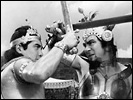 Inspired by Ben-Hur and The Ten Commandments, Daiei president Masaichi Nagata chose no less than the life of Buddha as the subject of Japan's first 70mm religious epic. Effectively gambling the studio's future on the project, he gave helming duties to Misumi, who was then emboldened by the success of his modest period pieces, which on several occasions had outgrossed Daiei's A-list productions.
The film moves through the deity's life from his renunciation of his father's fortunes and his lengthy meditation under the Bodhi tree, via the transformation of prince Siddharta into Buddha, to the miracles he performs for the poor and needy as his teachings spread across the land. The results are much as one would expect: big sets, thousands of extras, and an all-star cast of Daiei's top stars. Though inevitably less lavish and resplendent than the films that inspired it, this is certainly not for lack of trying, as the climactic destruction of an entire city shows. That all the Indian characters in the film are played by Japanese actors might raise an eyebrow, but Shintaro Katsu as Devadatta is certainly no more outlandish an image than Yul Brynner as an Egyptian pharaoh. (The only non-Japanese in the cast is Filipino actress Charito Solis, employed here mainly, it seems, for the size of her bosom.)
Buddha is occasionally clumsy and has histrionic performances to spare, but while it will never go down into Japanese film history as anything more than an amusing footnote, it does hold great value in the development of Misumi's signature style. The choice to show the Buddha only as a shadow or in silhouette after his emergence from under the Bodhi tree gives the director ample opportunity to experiment with the kind of expressionist compositions that would become such a characteristic in his later work, all the way down to the Baby Cart films.
Nagata's gamble, incidentally, paid off. The success of Buddha paved the way for Misumi to join the ranks of Daiei's top directors, men like Kon Ichikawa and Kenji Mizoguchi. The director declined the prestige, however, and preferred to keep working on his beloved chanbara. [TM]
Destiny's Son (Kiru, 1962)
- Cast
- Raizo ICHIKAWA, Shiho FUJIMURA, Masayo BANRI, Mayumi NAGISA, Junichiro NARITA
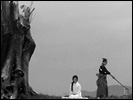 The same year Misumi directed the first Zatoichi film, he also made this forgotten masterpiece, a rapturously beautiful evocation of the plight of fatherless men (he himself was abandoned by his parents as a child) and the futility of bushido, scripted by Kaneto Shindo from a Renzaburo Shibata novel.
Shingo (Ichikawa) is the product of a scandalous affair between a guardsman and the woman he was assigned to execute. Unaware of his origins, Shingo grows up as the adopted son of a samurai family, but learns the truth upon his father's deathbed. Fatherless and masterless, he goes out into the world and finds employment with the clan lord Matsudaira to whom he devotes himself wholeheartedly. But even Shingo's superior swordsmanship can't avert Matsudaira's downfall at the hands of his enemies.
Destiny's Son is a film filled with stylistic highlights: the one-take dolly shot of Ichikawa's running battle with a battalion of swordsmen under an inky sky, the labyrinth of empty castle chambers through which he attempts to find his ambushed master, the scene in which the unarmed hero defends himself with a twig of cherry blossom, and especially the recurring flashback to his mother's execution at the hands of her own lover, in a barren landscape beside a single, ancient tree.
Perhaps most impressive of all, though, is the genuine doubt that speaks from the film as to the value of the warrior code and, by implication, of the samurai lifestyle as a whole. If the protagonist of Satan's Sword was merely a samurai who abused his position to give vent to his psychotic tendencies, in Destiny's Son the hero is the bushido ideal of the valorous and disciplined retainer, who, despite all his prowess with the sword and his noble heart, is powerless to prevent the deaths of those around him. [TM]
Ken (Ken, 1964)
- Cast
- Raizo ICHIKAWA, Yusuke KAWAZU, Yukiko FUJI, Akitake KONO
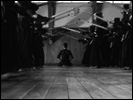 Among his 60-odd productions, Ken is Misumi's only film in contemporary setting. Although it falls outside the genre programmers he habitually worked in, it tellingly treats exactly the same theme as his period pieces: the conflict between bushido and humanism.
Based on the novella by Yukio Mishima (who allegedly was a great fan of Destiny's Son), Ken is the story of Jiro Kokubu (Ichikawa), star pupil of the university kendo club, for whom the sport is a way of life. Unwavering in his asceticism, he willingly foregoes girls, parties and rock music, devoting his entire being to the practice of kendo. The other students, in particular a fellow senior named Kagawa (Kawazu, star of Nagisa Oshima's early films), ridicule him behind his back, but are unable to better him in the dojo. On a training trip before a major tournament, where the group is subjected to Kokubu's gruelling regimen, Kagawa rebels, dragging the younger students with him on a collision course with their captain.
For Mishima, Jiro Kokubu was the embodiment of his ideals, a modern-day Japanese living by the warrior code, renouncing the temptations of hedonism and consumer society. He is the personification of the values the author detailed in his book-length essay Hagakure Nyumon, a study of the Hagakure, the book of the samurai, which the controversial writer considered his guide to life. Misumi takes a more distant look at the same story. Through the eyes of freshman student Mibu, torn between his admiration for his team captain and his wish to live it up before entering the adult world, the director weighs Kokubu's steadfast stoicism instead of idealising it. He adds more balance in the shape of a potential love interest for Kokubu, but with the obvious evil of swords and killing out of the way Misumi finds it far more difficult to come to a conclusion.
Shot in suitably high-contrast black and white, Ken is closer in style and tone to the seishun eiga (at times it evokes Kon Ichikawa's Punishment Room / Shokei no Heya, 1956) and the early works of the Japanese New Wave than to any of Misumi's own chanbara films. An overlooked gem that sheds a very different light on its director. [TM]
Zatoichi and the Chess Expert (Zatoichi Jigoku Tabi, 1965)
- Cast
- Shintaro KATSU, Mikio NARITA, Chizuru HAYASHI, Kaneko IWASAKI, Gaku YAMAMOTO
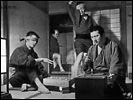 The twelfth entry in the Zatoichi series, and the director's third, marks the meeting of two giants of the chanbara film: Kenji Misumi and the towering Daisuke Ito. Starting his career in the silent era, Ito is one of the undisputed masters of the genre. A D.W. Griffith of the samurai film, he introduced a dynamic visual style of fast cuts and moving cameras and was one of the first to break away from the static visual tradition inherited from the theatre. With a career that lasted well into the 1970s, Ito was also one of the first to toy with what are often called nihilist heroes, protagonists that were quite different from the heroic and virtuous samurai stereotype.
A collaboration between two such greats creates a promise that, truth be said, the film doesn't quite fulfil. Zatoichi and the Chess Expert is a fine entry in the series, certainly, but no greater than any of Misumi's other contributions. The early section of the film replays an entire key scene from the original The Tale of Zatoichi (1962), but things pick up when a cool and menacing Mikio Narita makes his entrance as Jumonji, the chess player of the title. Initially becoming a travel partner to Zatoichi, leading to several fine chess match scenes including one where Jumonji levels the odds by playing blindfolded, his dark side reveals itself when Zatoichi meets a pair of teenagers looking for the man who murdered their father… during a chess match.
This is a solid enough entry in the series, boosted by fine camerawork from Misumi's regular cinematographer Chishi Makiura (using browns and reds as dominant colours) and several good scenes, including an opening sequence that is one of the best and most compact examples of Misumi's unique visual style. [TM]
Sword Devil (Kenki, 1965)
- Cast
- Raizo ICHIKAWA, Kei SATO, Michiko SUGATA, Goro MUTSUMI
 Hanpei (Ichikawa once more) is a soft-spoken gardener, a vassal without rank who is the butt of everyone's jokes. A persistent rumour goes around town that he was born from a coupling between a woman and a dog, and he is treated no better than the average canine. He meekly undergoes the repeated vandalism of his flowerbeds and the taunts of those who rank above him in the hierarchy.
But Hanpei's dim-witted appearance hides an enormous capacity from learning upon seeing. No sooner has he observed an again swordsman practicing his draws on a deserted hilltop, or he turns into swordfighter of frightening ability himself. Remarking his skills, one of the clan lieutenants slyly befriends the good-natured young man, winning his trust in the hopes of having Hanpei do his dirty work.
Misumi's second adaptation of a Renzaburo Shibata novel makes an intriguing companion to its predecessor, Destiny's Son. Both films deal with orphaned young men adopting father figures and being drawn into backroom intrigue despite their prowess with the sword. Sword Devil takes a more comic tone for the first part of its narrative, occasionally crossing the line into silliness, but with Ichikawa always convincing as the naïve Hanpei. Its parodic nature also makes it one of Misumi's strongest attacks on bushido values, with the downtrodden hero defeating dozens of highly trained aristocratic warriors by simply adhering to the sole lesson taught to him by the old samurai: "Just draw, kill and sheath. That's all there is to it." [TM]
Wrath of Daimajin (Daimajin Ikaru, 1966)
- Cast
- Shiho FUJIMURA, Kojiro HONGO, Taro MARUI, Takashi KANDA
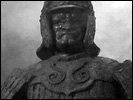 It's probably his involvement with studio franchises that has kept Misumi from being seen as more than a great craftsman by critics and historians. He was always content to be working in popular cinema, of which the Zatoichi series and above all this entry in the Daimajin trilogy are perhaps the ultimate examples.
The second in the trilogy, Wrath of Daimajin revolves around the good citizens of a prosperous coastal domain overrun by jealous invaders from the neighbouring clan. Subjecting the poor folk to tyranny, the barbarians hope to bring them to their knees by blowing up the stone statue of their god Majin. As the icon scatters into the sea in a thousand pieces, all hope seems lost, but a single escapee's persistent prayers bring the stone god back to life for some well-deserved payback.
A medieval variation on the kaiju films essentially aimed at young audiences, the Daimajin films are free of most of the more substantial elements of Misumi's major films. The story takes a very fatalist viewpoint of humanity, characters are drawn in unmistakable terms of good and evil and not a drop of blood is spilled despite healthy doses of action. As such, this is hardly a standout within the director's body of work, and for once really does see Misumi operating on the level of pure craftsmanship. No better or worse than the other two entries (directed by Kimiyoshi Yasuda and Issei Mori), this is enjoyable juvenalia and certainly preferable, nostalgia notwithstanding, to many of the same period's Godzilla films. [TM]
Baby Cart at the River Styx (Kozure Okami: Sanzu no Kawa no Ubaguruma, 1972)
- Cast
- Tomisaburo WAKAYAMA, Minoru OKI, Kayo MATSUO
In the beginning there was Shogun Assassin. At least, for many of us non-Japanese fascinated by samurai cinema's lightning swords of death. A perennial cult favourite, the composite film made under the auspices of Roger Corman famously cut together the best footage from Japan's Lone Wolf / Baby Cart series to come up with one hell of an exciting hack 'n' slash action film.
Donating the main bulk of footage to Shogun Assassin, Baby Cart at the River Styx was the second entry in the original film series, following Sword of Vengeance and preceding Baby Cart to Hades (both also directed by Misumi). Even among the other five episodes, River Styx stands out for the almost dreamlike beauty of its visuals, the flamboyant adversaries that cross the hero's path, the surreal succession of locations and of course for its unrelenting carnage. The blood spurts and flows in quantities big enough to fill the titular river as Ogami Itto and his son Daigoro trek across a surreal version of Edo-era Japan in pursuit of a trio of seemingly unbeatable assassins and the man entrusted into their care.
Brutal, exhilarating and absolutely gorgeous, Baby Cart at the River Styx remains a knockout film that has lost none of its might. One of those movies that has the power to convert legions of new fans to the cause of Japanese cinema. [TM]
Baby Cart in the Land of Demons (Kozure Okami: Meifumado, 1973)
- Cast
- Tomisaburo WAKAYAMA, Akihiro TOMIKAWA, Shingo YAMASHIRO, Eiji OKADA, Minoru OKI, Michiyo YASUDA
 Despite its enduring popularity in the West, the Baby Cart series is still often seen as consisting of two distinct parts. Ask any fan what his favourite episode is and he will almost invariably tell you it's one of the first three. The three later entries are often given short shrift. Certainly, Baby at the River Styx looms mightily over the others, but Buichi Saito's fourth instalment Baby Cart in Peril, with its riveting story of the vengeful Oyuki, her breast tattooed with a blood red Kintaro, and Yoshiyuki Kuroda's White Heaven in Hell, the least liked but ironically the most comicbook-like of all six, have their own special charm and deserve a re-evaluation.
So too does part five, Baby Cart in the Land of Demons, which marks the return of Kenji Misumi after a brief absence during which he made the first Hanzo the Razor film with Shintaro Katsu. Misumi's penultimate film, it's without doubt the darkest of the series, as well of Misumi's career. Its story is a relentlessly tale of backstabbing and betrayal, of double and triple crosses, as clan underlings hire Itto Ogami to dispose of their leader, who has for no apparent reason incarcerated his infant son and heir, and replaced him with a girl he has adopted. Meanwhile, Ogami loses track of his own son Daigoro, who falls in with a lady pickpocket but is arrested by the constable on her tracks and subjected to a public whipping.
In parallel with its darkness, Baby Cart in the Land of Demons is the strongest evocation of the father-son bond in Misumi's work. Ogami's job is to kill a child and its foster parents so that the real son may be freed, while a close-up of Ogami and Daigoro's tightly clasped hands after the boy's ordeal is held so long that it becomes an almost desperate outcry. Here, the director's humanism is struggling to wrench itself loose from its violent bonds, something that would finally be achieved in Misumi's next and final film, The Last Samurai. [TM]
The Last Samurai (Okami yo Rakujitsu o Kire, 1974)
- Cast
- Hideki TAKAHASHI, Ken OGATA, Keiko MATSUZAKA, Takahiro TAMURA
 Misumi's The Last Samurai takes place in the same period and setting as its later Hollywood namesake. But this is where similarities end. Instead of Ed Zwick's naïve celebration of bushido and feudalism as something quaint, exotic and idyllic, Misumi draws a thick red line through Tokugawa and samurai society, renouncing it once and for all as an inhuman dictatorship. His final film sees him making the choice that he had been weighing and contemplating for his entire career.
Set during the 19th-century social upheaval that helped bring three centuries of shogunate rule to its knees, The Last Samurai follows Toranosuke (a physically and dramatically impressive Takahashi, former star of Seijun Suzuki's Fighting Elegy and Tattooed Life), a paragon of the valiant samurai who is confused by the changes happening around him. His codes tell him to defend the shogunate on the side of the Shinsengumi militia, but his teacher (Tamura of Yasuzo Masumura's Hoodlum Soldier series) has already defected to the other side and tells him it's time to lay down the sword and look toward the future. When the latter stealthily arranges for Toranosuke to meet the beautiful Reiko (Matsuzaka), the warrior's doubt begin to grow.
Made for Shochiku studios, the epic The Last Samurai sees the director operating in a more naturalist, down-to-earth style that combines well with the overall humanist tone of the film, as if the director wanted to get rid of any hint of sensationalism. Gone are the thick shadows, the splashes of primary colour and the intense close-ups. They are replaced by a palette of earthy tones and a more sedate use of the camera. The exaggerated violence so often seen as a trademark of Misumi's work surfaces here only once, in the scene in which the furious Toranosuke goes after the trio of soldiers that killed his wife, and it comes across as suitably jarring.
With The Last Samurai, Kenji Misumi does something that few artists ever have the chance to do: deliver his final and definitive statement, reaching a conclusion that brings his entire body of work to a close. A genuinely great film. [TM]